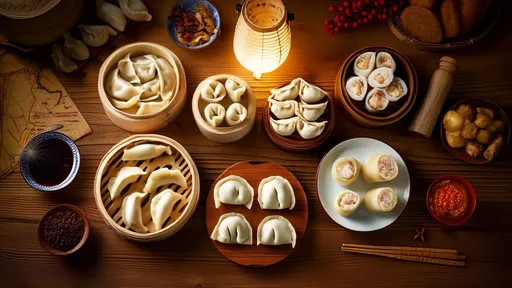
The humble dumpling, a culinary staple across continents, carries within its pleats and folds a wealth of cultural history. From the delicate har gow of Cantonese dim sum to the robust pierogi of Eastern Europe, each wrapping technique whispers stories of migration, adaptation, and identity. This investigation into forty global dumpling forms reveals how something as simple as flour and water transforms into edible anthropology.
In the alleyways of Xi'an, where the Silk Road once thrummed with merchants, the jiaozi takes on crescent moons of significance. The tight, accordion-folded edges aren't merely functional - they mimic the rippling dunes of the Taklamakan Desert, a visual prayer for travelers. Contrast this with the Ukrainian varenyky, their half-moon shapes pinched with thumbprints resembling embroidery patterns from peasant blouses. What appears as mere aesthetic choice actually encodes regional craftsmanship traditions in edible form.
The crimping patterns of Central Asian manti tell a different tale. The four-cornered gather, requiring precise fingertip pressure, mirrors the geometric precision of Islamic tile work. During fieldwork in Uzbekistan, elderly women demonstrated how the number of pleats indicated a family's ancestral village - twelve folds for Samarkand lineages, fourteen for those tracing roots to Bukhara. Such edible cartography persists even in diaspora communities, where grandmothers teach the exact tension needed to stretch dough over spiced lamb without tearing.
Latin America's empanada crimps functioned as edible signatures. In colonial Argentinian bakeries, enslaved Africans developed distinct edge patterns to identify their creations, a silent rebellion against erasure. The repulgue technique - looping folds resembling rope - later became points of regional pride. Meanwhile, in the Philippines, the spiral-closed siopao reflects Chinese merchant influence, its swirling top mimicking the waves that carried junks to Manila's ports.
Even the "failed" dumplings hold meaning. Nepali momo makers intentionally leave one batch with ragged seams during festivals, representing life's imperfections. The Jewish kreplach, traditionally eaten before Yom Kippur, features deliberately uneven triangles symbolizing the uneven scales of judgment. These culinary "flaws" serve as philosophical reminders encoded in dough.
Modern fusion dumplings now layer these histories. A Tokyo pop-up serves gyoza with Polish pierogi folds, while a New Orleans chef stuffs Cajun crawfish into Vietnamese banh bot loc wrapping. This cross-pollination creates living documents of globalization - not as homogenization, but as a conversation conducted in pleats and pinches. As one Uzbek elder remarked while teaching her granddaughter to pleat manti: "The dough remembers what our minds sometimes forget."

By /Jul 7, 2025
By /Jul 7, 2025
By /Jul 7, 2025
By /Jul 7, 2025

By /Jul 7, 2025
By /Jul 7, 2025

By /Jul 7, 2025
By /Jul 7, 2025
By /Jul 7, 2025

By /Jul 7, 2025
By /Jul 7, 2025

By /Jul 7, 2025

By /Jul 7, 2025

By /Jul 7, 2025

By /Jul 7, 2025

By /Jul 7, 2025

By /Jul 7, 2025

By /Jul 7, 2025

By /Jul 7, 2025

By /Jul 7, 2025
